
- HOME
- Products & Services
- Purification
Purification
Purification
1. Gel Filtration Purification / Desalting
[Supported Products]
DNA Synthesis
(11 – 50 mer) RNA Synthesis
(11 – 40 mer)
This method removes low-molecular-weight impurities such as protecting groups generated during synthesis. Due to the principle of separation, high-molecular-weight impurities cannot be removed. As a result, oligonucleotides with missing or extra bases may be present together with the target sequence.
For short oligonucleotides (≤10 mer), the recovery may be significantly reduced.
This method is suitable for applications such as DNA fragment amplification.
2. Cartridge Purification
[Supported Products] * 11–40 mer when including RNA.
DNA Synthesis
(11 – 70 mer) RNA Synthesis
(11 – 40 mer) Modified Oligonucleotide Synthesis
(11 – 70 mer)*
This method uses a reverse-phase cartridge column and provides higher purity than gel filtration purification. However, because separation efficiency may decrease for longer sequences due to the properties of the resin, we recommend this method for sequences up to 70 mer (up to 40 mer when containing RNA).
This method is suitable for sequencing primers and PCR for subcloning.
■ In-house Results ■
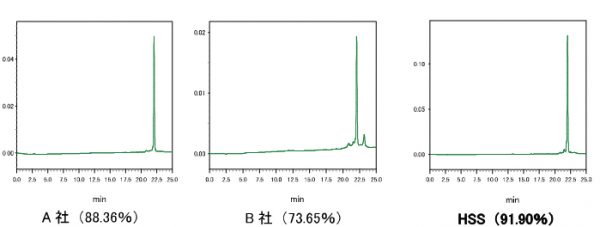
RP-HPLC Analysis: 30 mer DNA
3. Cartridge Purification with MS verification
[Supported Products]
DNA Synthesis
(11 – 50 mer)
Target product is confirmed by LC-ESI-MS after cartridge purification.
4. HPLC Purification
[Supported Products] * 11–70 mer when including RNA. The maximum supported length may vary depending on the sequence and modifications.
DNA Synthesis
(11 – 120 mer) RNA Synthesis
(11 – 70 mer) Modified Oligonucleotide Synthesis
(11 – 99mer) Scale-Up Synthesis
(11 – 120 mer) ※
This versatile purification method is widely used for long DNA (≥30 mer) and various modified oligonucleotides, and effectively removes many impurities generated during synthesis.
At our facility, reverse-phase HPLC is employed, and products up to 50 mer are verified by LC-ESI-MS.
Recommended for high-precision applications such as mutagenesis and antisense experiments.
■ In-house Results ■
RP-HPLC Analysis: 40 mer DNA
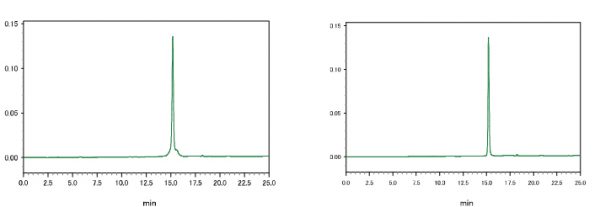
Conventional HPLC-purified product (Purity = 90.24%) Our proprietary HPLC-purified product (Purity = 98.32%)
5. Ion-Exchange HPLC Purification
[Supported Products]
DNA Synthesis
(11 – 30 mer)
This purification method enables separation at the single-base level and allows easier removal of deletion sequences generated during synthesis compared with conventional HPLC.
All applicable products are verified by LC-ESI-MS to confirm their identity.
For higher purity requirements, we recommend ion-exchange HPLC purification following reverse-phase HPLC (see 7. High Purity Purification for details).
6. PAGE Purification
[Supported Products]
DNA Synthesis
(11 – 200 mer)
This method yields high-purity DNA purified by polyacrylamide gel electrophoresis (PAGE).
For products up to 50 mer, identity is verified by LC-ESI-MS.
Suitable for applications such as long DNA synthesis and artificial gene construction.
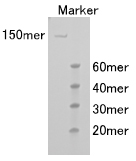
PAGE-purified 150 mer synthetic DNA
7. High Purity Purification
[Supported Products]
DNA Synthesis
(20 – 50 mer)
By combining multiple purification methods, deletion sequences and other impurities are thoroughly removed, achieving an average purity of approximately 98%.
All applicable products are verified by LC-ESI-MS to confirm their identity.
20–30 mer: HPLC + Ion-exchange HPLC
31–50 mer: HPLC + PAGE
Ideal for applications requiring the highest level of accuracy.
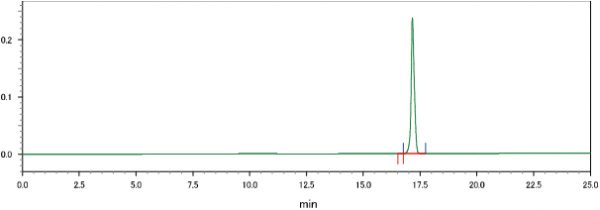
High-purity synthetic DNA (25 mer) — Purity: 99.93%